


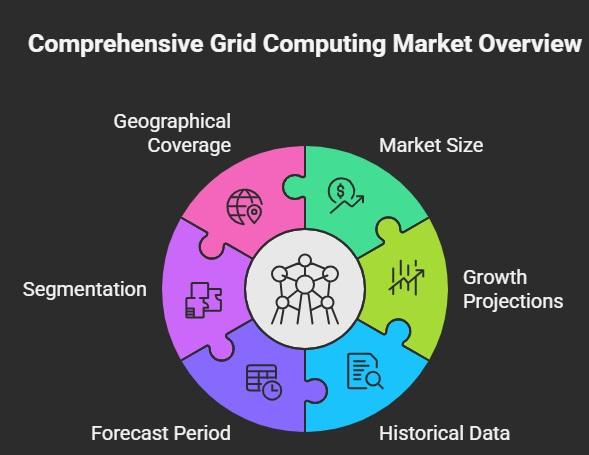
The Grid Computing Market is emerging as a strategic backbone for enterprises that require massive, distributed compute without the cost of centralized supercomputers. Fueled by AI workloads, hybrid cloud strategies, and the need for cost-efficient high-performance computing, the sector is attracting investment from service providers, enterprises, and research institutions. According to one industry forecast, the market is expected to register a CAGR of 16.2% from 2025 to 2031.
Market size — what the numbers show
- Baseline (2024): the Grid Computing Market is estimated at US$ 5.18 billion in 2024.
- Applying the industry CAGR of 16.2% from 2025–2031 (the standard forecasting window referenced by market reports) yields an estimated market size of approximately US$ 14.82 billion by 2031 (calculated). This represents near-tripling in value and underscores rapid adoption across industries that require large-scale parallel processing. (Calculation based on 5.18B × (1 + 0.162)^7.)
Why this growth is credible
- Rising AI, machine learning, and big-data workloads have shifted demand toward distributed compute models that can pool geographically dispersed resources efficiently. Cloud and AI infrastructure expansion is widening the opportunity for grid architectures that can orchestrate heterogeneous resources.
- Cost-efficiency and resource optimization: organizations use grid computing to monetize idle compute, reduce capital expenditure, and scale compute elastically for peak jobs.
- Vertical demand: BFSI, healthcare & life sciences, manufacturing, and utilities are large adopters—especially where simulations, genomics, and large-scale analytics are mission-critical.
Market dynamics — what businesses should watch
- Consolidation of cloud, edge, and grid paradigms: expect hybrid offerings (cloud + grid orchestration) to proliferate as vendors aim to provide transparent scheduling and workload portability.
- Services-led revenue: professional services, managed orchestration, and consulting are high-margin complements as enterprises adopt heterogeneous grid environments.
- Regulatory and data-sovereignty constraints will favor on-premise and hybrid grid deployments in regions with strict data rules.
Quick business-focused takeaways (bullet points)
- Market outlook: CAGR 16.2% (2025–2031); approx. US$ 5.18B (2024) → US$ 14.82B (2031, est.).
- Top demand drivers:
- AI/ML model training and distributed inference.
- Large-scale simulation (manufacturing, oil & gas, life sciences).
- Cost savings via pooled, underutilized compute resources.
- High-opportunity segments: managed grid services, orchestration software, cybersecurity for distributed compute, and verticalized solutions for life sciences and BFSI.
- Risks to monitor: interoperability fragmentation, rising competition from centralized cloud/HPC players, and integration complexity.
Strategic recommendations for market players
- Productize orchestration — build easy-to-integrate schedulers and APIs that make it simple to move workloads between cloud, edge, and grid nodes.
- Verticalize offerings — bundle domain-specific modules (e.g., genomics pipelines, CFD workflows) to accelerate enterprise adoption.
- Partner with cloud & edge providers — interoperability deals and hybrid billing models will shorten sales cycles and reduce customer friction.
- Invest in security & governance — data locality and workload provenance features will become key buying criteria for regulated industries.
Conclusion
The Grid Computing Market represents a high-growth, strategically important segment of enterprise computing. With a projected CAGR of 16.2% (2025–2031) and an estimated climb from US$ 5.18 billion in 2024 to roughly US$ 14.82 billion by 2031, the opportunity is substantial for vendors who can deliver seamless orchestration, vertical solutions, and robust governance. Firms that prioritize integration with cloud/edge ecosystems and package domain-specific value will capture the largest share of this rapidly expanding market.

 English