


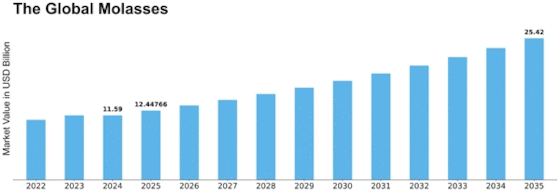
Natural sweeteners and functional ingredients are becoming a staple in both food and feed industries, driven by consumer awareness and evolving dietary preferences. Molasses, a by-product of sugar production, offers a rich source of minerals and energy, making it a versatile ingredient across various applications. Its historical use combined with modern innovations has reinforced its relevance in contemporary markets.
The Molasses Market is expanding rapidly as industries seek multifunctional, cost-effective, and nutrient-dense ingredients. Molasses is not only an energy source but also a natural flavor enhancer, which makes it attractive for both food and livestock feed applications. Its ability to meet clean-label and sustainable production trends adds to its market appeal.
One of the key applications driving growth is molasses for livestock feed, where it enhances feed palatability and energy intake. It is used widely in cattle, swine, poultry, and aquaculture diets to improve nutrient absorption and animal productivity. Livestock producers increasingly rely on molasses as a cost-efficient supplement in feed formulations.
The organic and natural molasses segment is also witnessing significant growth. Consumers and manufacturers are increasingly focusing on minimally processed ingredients that are free from synthetic additives. Molasses aligns perfectly with this trend, providing natural sweetness, mineral content, and versatile usage across bakery, confectionery, and beverage industries.
Molasses usage in animal feed US has grown substantially due to its effectiveness in livestock nutrition programs. Its role in enhancing feed efficiency and promoting overall animal health has strengthened its position in the North American agricultural landscape. Farmers and feed manufacturers recognize its value in improving productivity and sustainability.
Furthermore, the molasses market trends and forecast indicate continued adoption in organic food, livestock feed, and functional food sectors. Innovations in product formats, value-added applications, and organic offerings are expected to support steady growth. As consumer demand for natural, nutrient-rich, and sustainable ingredients rises, molasses is well-positioned to meet these needs.
Top Leading Key Players
Cargill (US), Tate & Lyle (GB), American Crystal Sugar Company (US), Domino Sugar (US), Mizkan Holdings (JP), Ragus Sugars (GB), Shree Renuka Sugars (IN), Bunge Limited (US), Südzucker AG (DE)
Table of Contents
SECTION I: EXECUTIVE SUMMARY AND KEY HIGHLIGHTS
SECTION II: SCOPING, METHODOLOGY AND MARKET STRUCTURE
SECTION III: QUALITATIVE ANALYSIS
SECTION IV: QUANTITATIVE ANALYSIS
SECTION V: COMPETITIVE ANALYSIS ........
FAQs
How does the valuation of dark molasses compare to blackstrap molasses?
In 2024, dark molasses was valued at 3.45 USD Billion, while blackstrap molasses was valued at 4.12 USD Billion.
What are the main sources of molasses in the market?
The main sources of molasses include sugarcane, sugar beets, and others, with sugarcane valued at 5.79 USD Billion in 2024.
What is the projected market valuation for The Global Molasses in 2035?
The market is projected to reach a valuation of 25.42 USD Billion by 2035.
Related Report:
brazil ready to eat meals market

 Chinese