


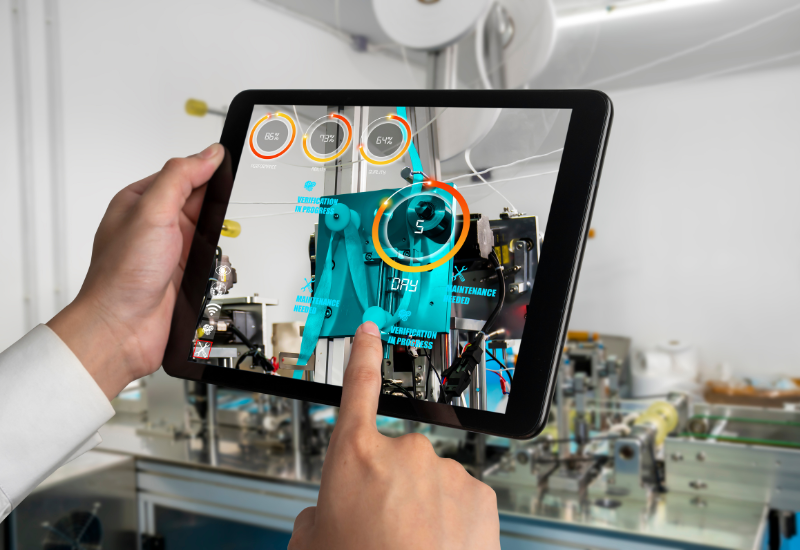
The rapid evolution of immersive technologies is unlocking a powerful new era where enterprises can visualize processes, optimize operations, and enhance human-machine interaction in ways never previously achievable. This transformation is clearly reflected in the rising global augmented reality market size, which continues to accelerate as industries shift toward hybrid digital ecosystems. Augmented Reality Market Size was estimated at 50.25 USD Billion in 2024. The Augmented Reality industry is projected to grow from 68.08 USD Billion in 2025 to 1419.67 USD Billion by 2035, exhibiting a compound annual growth rate (CAGR) of 35.49 during the forecast period 2025 - 2035. These numbers highlight AR’s expanding influence as organizations adopt immersive overlays for diagnostics, remote support, advanced collaboration, workforce training, and complex visualization.
In the overview of today’s AR ecosystem, the transformation is driven by the convergence of mobile computing, 5G, AI, and real-time analytics. Companies now use AR not as an entertainment accessory but as a critical operational component that enhances accuracy in manufacturing, logistics, healthcare, automotive assembly, and product design. The seamless integration of digital twins, multi-layered holographic instructions, and context-aware overlays is replacing traditional manuals and static training modules. The enterprise adoption wave is creating a dynamic future where machines, people, and digital content interact effortlessly.
Key players shaping this market include Meta, Microsoft, PTC, Qualcomm, Google, Magic Leap, and Apple, who continue to advance AR’s reach by developing smarter glasses, advanced processors, and spatial computing frameworks. Their innovations support cross-platform AR deployment, immersive collaboration tools, and business-grade visualization assets designed to scale across industries. Strategic partnerships with industrial manufacturers, healthcare leaders, and retail giants help expand user adoption globally.
Looking toward the future of AR, the shift toward ultra-light wearable optics, AI-enhanced object detection, and metaverse-linked enterprise applications will become defining growth catalysts. As industries evolve toward intelligent automation, AR will serve as the intuitive layer that guides humans through complex operational tasks—reducing errors, improving safety, and boosting productivity. With holographic collaboration, interactive product design, immersive field service support, and hands-free navigation, AR’s future extends far beyond entertainment, positioning itself as a cornerstone of next-gen productivity.
Regionally, North America dominates due to strong infrastructure and major technology companies driving innovation, while Europe advances through industrial automation, smart factories, and automotive engineering. Asia-Pacific is the fastest-growing region, supported by rising tech investments, manufacturing hubs, and expanding gaming ecosystems in China, Japan, South Korea, and India. Meanwhile, the Middle East and Latin America are adopting AR in urban development, oil & gas training, retail enhancement, and public safety applications.
Crucial market insights reveal that AR is transitioning from an optional enhancement to a mission-critical solution for digital transformation. As spatial computing, AI, and cloud technologies continue to merge, AR will deliver unprecedented value through intelligent guidance, automation, and immersive contextual analytics.
Top Trend Reports:

 Chinese